Wednesday, 8 April 2026

Dharma, Karma and The Cross

The Dharma, Karma and The Cross

Between birth and death stretches the quiet field of a human life.

What came before our birth remains hidden from us.
What lies beyond death is equally veiled.

But between these two mysteries we are given a journey.

Many traditions have tried to understand this journey.
Some speak of dharma, the duty and order into which we are born.
Some speak of karma, the consequences of what we do within that order.
Together they form the path each person must walk.

In another tradition, Jesus Christ spoke of the Cross.

“Pick up your cross and follow me.”

Perhaps these ideas are not so different.

The cross may simply be the life already placed upon our shoulders.

We did not choose our parents.
We did not choose the family or circumstances into which we were born.
We inherit an emotional world, a culture, a language, expectations and responsibilities.

From there the road continues:

education, work, relationships, marriage, children, duties, disappointments, hopes.

This is the shape of our cross.

Yet human beings often try to exchange the cross given to them for another of their own making.

We choose careers that are not truly ours.
We form relationships for reasons that do not belong to our deepest self.
We run away from responsibilities that seem too heavy.

For a time it feels like freedom.

But often it is only a detour.

Life has a patient wisdom.
Sooner or later it brings us back to the unfinished task we tried to escape.

And then we begin to understand something simple but profound.

The real question is not which cross we carry, but how we carry it.

Every tradition teaches this in its own language.

The path may be called dharma.
The consequences may be called karma.
Or the burden may be called the cross.

But the truth beneath them is the same.

We must live the life that has been entrusted to us.

For my own heart, the path I have chosen is the way of the Cross of Jesus Christ.

Yet the deeper lesson remains universal.

We did not choose our cross.
But we can choose the spirit with which we carry it.

In that spirit lies dignity.
In that spirit lies faithfulness.
And in that spirit lies the quiet possibility that even the heaviest burdens of life may become a path toward meaning and peace.

Saturday, 21 March 2026

Ecce Homo

On a Sunday early morning, I rode my scooter across town to visit an elderly gentleman who lives alone.

When I reached, he smiled kindly but said it was too early for him, and asked if we could meet another time.

So I turned back—not disappointed, just unhurried—and made my way to the jetty. From there, I took a junkar boat across the Cochin ship channel toward Vallarpadam.

It was then that I noticed a board announcing the exposition of the centuries-old Ecce Homo—a special grace offered during Lent.

History came alive in that moment. In 1663, when the Dutch conquest of Cochin drove out the Portuguese from Fort Cochin, the Catholic community was forced to flee. They carried with them their altar and the revered Ecce Homo, taking refuge across the waters at the Our Lady of Hope Church.

Most likely, this remains one of the oldest living devotions connected to the first European Catholic church in India.

And I could not help but think—had the gentleman received me that morning, I would have missed this grace entirely.

Sunday, 2 November 2025

All Souls Day

Today we remember not only our own dear departed ones, but also those who once walked the streets of old Cochin over the past five centuries, under a foreign sky.  

They came to this coast with hope — some bearing the cross, some the compass, some the dream of a better world. Many labored with honesty, taught, healed, served, and died far from their homeland, leaving behind no stone, no family name, no lighted candle to mark their rest.

  Here, in this place of tides and ships, we remember them too — the souls without descendants, builders without monuments, believers without names.  

May the sea that carried them be gentle to their memory. May the light of God, whom they sought in their own way, shine upon them now and forever.  

Every life, named or forgotten, has left a trace in the soil beneath us. To remember them is not an act of sorrow, but of gratitude; a quiet acknowledgment that we are the living continuation of their prayers, their courage, and their unfinished hope.  

Without them, there is no us — no language upon our tongue, no road beneath our feet, no faith carried in our hearts.  

"Eternal rest grant unto them, O Lord, and let perpetual light shine upon them. May they rest in peace. Amen."

Saturday, 1 November 2025

All Saints Day

All Saints’ Day is the special day each year when the church honors those who have lived truly saintly lives whether they are recognized, canonized, or simply known to God alone. It is a day to remember not only famous heroes of faith but also the quiet souls who served with love and dedication. Living a holy life is not a matter of ambition or status but a daily commitment that brings inner peace and joy. On this day, candles are lit not only for those in heaven but also as a gentle reminder that we can cultivate peace and joy here on earth, in our hearts. Each candle sparks hope and inspires us to follow their example in every moment of our own lives.

Monday, 6 January 2025

362 years and still waiting for their Masters..


Fort Cochin, with its cobblestone streets and colonial-era architecture, holds stories that transcend time. Among them is the tale of the Kappiri—a symbol of resilience, history, and remembrance.

During the Portuguese rule, enslaved Africans, locally called Kappiri, were brought to the Malabar Coast. These individuals lived through immense hardship, shaping the region’s history in ways often overlooked. When the Dutch seized Fort Cochin in 1663, folklore says that wealthy Portuguese buried their treasures underground. To protect these riches, they reportedly buried their loyal Kappiri guards alongside, tying their spirits to the land forever.

Far from being seen as ominous, the Kappiri are remembered with respect and even reverence. Small shrines, known as Kappiri Muthappan, still stand across Fort Cochin. Locals light candles at these shrines, honoring the memory of those who lived and suffered in a tumultuous era.

The story of the Kappiri isn’t just about loss—it’s about resilience and the deep layers of history that make Fort Cochin what it is today. It’s a reminder of the lives and cultures that shaped this land and the importance of acknowledging their stories.

Have you ever visited one of these shrines or heard about the Kappiri? 

Friday, 3 January 2025

The Echoes of Yesteryear: A Carnival through Time

Every year, Fort Cochin rings in the New Year’s Day with the rhythm of music, the colours of tradition, and the vibrant hum of over a hundred thousand people. Our beloved carnival isn’t just an event—it’s a celebration of the spirit of this town, a mosaic of history, culture, and shared joy.

But this year, the carnival arrived with a softer stride. Postponed to honour the passing of our honourable Ex-Prime Minister, Dr. Manmohan Singh, the day carried a solemnity that whispered through the streets.


I found myself sitting on the steps of a pharmacy at Kunnumpuram, waiting for the tableau to make its way as the evening grew long and the tropical winter coolness breezed in. Around me, the usual crowd was thinner, the buzz quieter, and the laughter more subdued. An elderly German couple was sitting beside me on the steps, the lady who was very enthusiastic about the events went out onto the road where the Carnival Procession was walking by and came back to her husband and told him very excitedly what she saw in their language. Her joy was contagious and made me nostalgically think about all those tourists who have been here from different countries on the New Year’s Day over the years.


 In the previous years the New Years day would make all the roads of our Old town lead to Fort Cochin, her narrow streets brimming with tourists, visitors and local residents their awe blending seamlessly with the exuberance of locals. The fragrance of freshly cooked delicacies, the burst of colourful energy from street performers, and the joy of togetherness all felt like distant echoes of a time gone by.


This year’s carnival wasn’t as lively, but perhaps it was a reminder—a gentle nudge to cherish the traditions that bind us and the memories that shape us. Even in its quieter form, not many years far from the shutdown nothingness of the Corona Years, the carnival held its charm, grounding me in a moment of reflection amidst the waiting crowd.

As the tableau finally came into view, its colours and music reminded me that while times change and moments pass, Fort Cochin’s heart beats steadily, carrying forward the legacy of countless New Year celebrations and the memories of folks who visited and those who lived here since Vasco Da Gama died  500 years ago  on the Christmas eve  of 1524.


The carnival may have been quieter this year, but its spirit endures—etched into the soul of this town and into the hearts of all who have walked these streets.


Thursday, 26 December 2024

500 Years since Vasco Da Gama 's arrival!

A heartfelt memorial and reflection on Vasco da Gama's legacy and the enduring Catholic community of our land.
Commemorating 500 Years of Vasco da Gama's Legacy

Christmas Eve, 2024

Five centuries ago, on Christmas Eve of 1524, one of history’s greatest navigators, Vasco da Gama, took his final breath in this very town. Known as the pioneer of the sea route to India, Vasco da Gama’s voyages changed the course of history, bridging two distant worlds and laying the foundation for centuries of cultural, economic, and spiritual exchange.
The incredible Portuguese Caravel by the name Sao Gabriel in which Vasco Da Gama sailed to India as drawn by the artist Ernesto Casanova (1845 - )

In life, Vasco da Gama was driven by the call to explore, to connect, and to expand horizons. His arrival in India in 1498 marked the beginning of a profound chapter in the history of this land. But his death here in 1524, far from his homeland, marked the completion of his extraordinary journey—a journey that not only linked continents but also left an enduring legacy in this community.

After his death, his remains were laid to rest in this town, sanctifying the soil with the presence of a man whose voyages reshaped the world. Though his son later repatriated his remains to Portugal in 1538, the significance of his final days here remains etched into the history of this place.

A Legacy of Faith and Resilience
Vasco da Gama's arrival heralded the beginning of Catholicism in this region. Missionaries and priests followed in his wake, spreading the Gospel and establishing a thriving Catholic community. Over the centuries, this faith has flourished, weathering the storms of time with resilience and grace. Today, the Catholic population in this town stands as a living testament to the spiritual seeds planted during Vasco da Gama’s time.

Churches, some centuries old, dot the landscape, their bells ringing out with a timeless call to prayer and devotion. The vibrant celebrations of Christmas, Easter, and feast days continue to bind the community together, preserving traditions while embracing modernity. The influence of Catholicism is deeply woven into the cultural fabric of this town, visible in its festivals, architecture, and the enduring spirit of its people.

500 Years On: Honoring the Past, Celebrating the Present

As we gather on this Christmas Eve of 2024, we pause to remember Vasco da Gama, whose life and death connect this town to a larger global story. We honor his legacy, not only as a navigator of uncharted waters but as a bridge between civilizations.

We also celebrate the strength and vitality of the Catholic community that continues to thrive here—a community rooted in faith, guided by hope, and united in love. The enduring presence of this faith reminds us of the shared values that bind humanity across time and geography: compassion, service, and the search for meaning.

Looking to the Future

On this quincentenary of Vasco da Gama's passing, let us reflect on the enduring legacy of his journeys. May his story inspire us to build bridges rather than barriers, to seek understanding across differences, and to celebrate the richness of our shared humanity.

And as we light candles in our homes and churches this Christmas Eve, let us remember the light that Vasco da Gama’s voyage brought to this town—a light that continues to shine brightly through the faith and fellowship of its people.

May the memory of Vasco da Gama, and the thriving Catholic community he left behind, guide us into the future with hope and unity.

Tuesday, 3 December 2024

November 30

A lone candle burning at a cemetery of a church in Kochi.

Some of the churches had some events planned on the end of November 30th. The month is marked for remembering the dead in many of the churches. All Saints & All Souls Day at the beginning of the month, then the Remembrance Day and in some countries the Thanks Giving Day. In a historical Coastal town like Fort Cohin/Kochi, where thousands of people from different countries had visited over the centuries for various reasons, many of them lay buried here. As the month of November passes, we remember gratefully all those who had brought a positive change to our people thoughts and lives. May you all Rest in Peace.

Friday, 8 November 2024

The Kerala School Sports & Games 2024

The meet is on at different venues in the district and the athletic events will be held at the Maharajas College Ground.
For those tourists who like to meet the participating students, their teachers, parents who are from the different districts of Kerala, the event is a good opportunity. 
Take a customised tour with us, ideally from 4pm in the afternoon to 8pm or till the end of the events and dinner afterwards from your favourite city restaurant. 
The pick up can be arranged from the water metro Jetty and drop back to Fort Kochi in a car. 

Thursday, 7 November 2024

Durham Miners' Banners

Durham Miners’ Gala

Solidarity forever! Banners of the Durham mining community.
Commemorating the 40th anniversary of the Miners’ strike of 1984-85 and celebrating the continuity, solidarity of the Durham Mining Communities a colorful selection of the banners from the region’s many Union Lodges were displayed at the Durham Cathedral recently.

Banners are described as the regimental colors of the National Union of Mineworkers. Banners were proudly carried at the Miners celebrations, protests and other events. Banners are made of silk and hand painted on both sides to display the name of their colliery lodge, along with other religious or political images. Many banners are still in use with their communities and are paraded through the streets of Durham on Gala day in July. They are joined by the banners of other trade Unions and groups linked to the mining communities such as the Women’s Support Groups.
The North East of England has a long history of coal mining. Centuries ago coal was used by the Romans while they occupied England. Mining activity is recorded in the Boldon book of 1183. Durham and the cathedral were at the heart of coal mining activity in the region, the industry endured for more than 9 centuries.

John Doyle’s ‘A cross in Coal’ emotionally expresses the sentiments in literary works of the time:

 ‘For here beneath dear Durham Skies live men, I understood, bound fast in friendship by the ties of pitman brotherhood…”

The Miners’ Gala started as a demonstration of Miners Solidarity to make their employers aware that they were united and would stand up for their rights. It was held every year and over the decades ‘the big meeting’ became the largest unofficial miners and trade union gathering in the UK.
Eventually the deep mines in the North East of England were closed but the Gala has survived as the Region’s mining heritage and attracting tens of thousands of visitors to Durham in July the month in which the Gala is held every year. It symbolizes celebration of a community, international solidarity and working class life.

On the afternoon of the Gala day a Miners’ Festival Service has been held at the Durham Cathedral. New Union and Lodge Banners are dedicated and blessed by the Bishop of Durham.
The pictures and information was sent to us by Ms.Catherine Henderson a Durham resident who has never missed a Gala of the last few decades. She took the Fort Cochin Heritage Walk in 2017 and has stayed a friend since. 

Thursday, 31 December 2020

Farewell 2020

Long ago, Thomas Carlyle, told, " A man must get his happiness out of his work. His first of the many  problems is to find the work he is meant to do in the world. Without work he enjoys he can never know what happiness is." He then went on to coin his famous phrase, " Know thy work and do it." 
2020 took that joy out from us yet we believe we are blessed to be alive at the end of it. As the year take its leave, we rise our parting glass as a friend and brother, 
"Thank you for the lessons, 2020!"

Monday, 30 December 2019

Christmas Eve

On the Christmas eve of 1524, Vasco Da Gama, the greatest of all the sailors, on his third visit to India, died at Fort Cochin and was buried at the historical church of St. Francis. 496 years, since.
Vasco Da Gama
Worlds Most prestigious documents by UNESCO, "Memory of World Register" established in 1992, contains 299 documents from five continents. One of them is Vasco Da Gama's hand written journal of his first voyage to India during which he arrived at Calicut on May 20th of 1498. It is written by a mysterious man aboard the ship and contains the misfortunes and triumphs of the voyage sharing in words every step taken by the adventurous sea man and his crew. Undoubtedly an exciting read about the incidents that changed the history of the world. The journal contains first hand witnessing of treason, diseases, meeting with our ancestors, war equipments, animals, plants, trees, musical and nautical instruments, food, villages, difficult navigational situations etc and also Portuguese words for the Calicut words.
Vasco's sea route
Vasco Da Gama was lucky to find a Mohmedian navigator from the eastern coast of Africa, Ahmad Ibin Majid, who guided Vasco to India. Arab sailors were experts sailors in the Indian Ocean and they knew the routes they were sailing for centuries very well. 

Vasco's second visit in 1502 was more guided by the economies of trade, religion and politics to establish a foothold and monopoly trading rights for his King and country and is marred with events of brutality as he confronted Mohmedians whom he saw again on the Malabar Coast, the very traders and their religion Vasco's country was in war with in Europe. 

After Vasco's return to Portugal in 1503, Francisco De Almeida, established a fruitful contact with the Kochi Kings attaining more than a foothold and trading rights and they increased their influence all around the Indian coast. Almeida was made the first Governor and Viceroy of Portuguese India in 1505.

Vasco Da Gama came again in 1524, on his third visit as Viceroy, but fell sick and died on the Christmas Eve.

The illustrious Mariner was bestowed with Hereditary Royal Pension, Dom status (Lord), the title of Admiral of the Seas of Arabia, Persia, India and all the Orient. After 16 years from his death, Vasco's remains were taken back to Portugal by his son and is enshrined in a fitting mausoleum in Jeronimo Monastery, his country's everlasting tribute to the greatest among the ones who have sailed the seas. 

Reference:
Economic Times, June 20, 2013
http://www.mosteirojeronimos.gov.pt/en/


Monday, 3 June 2019


Our Fort Cochin is a wonderful mixture of interesting narratives. 

Friday, 11 January 2019

Data Quest and PC Quest have been nostalgic technology magazines which we have grown up with when technology was slowly creeping into our lives and the news and information about the developments were not easily available. These magazines in the 90's were great source of information. Who would have thought one day Mr. Shyam & Mrs. Seema Malhothra would take our walk in Fort Cochin. Seen here in the picture is our walkers with Barbara and Zelda, the artists from Italy on a tour around India.
 
It was also a good start for us and our presenter who has just returned from a semester long lecture at a tourism college in Nellore.
Happy New Year, Friends, may we continue to give our best in everything we do.


Saturday, 27 October 2018

Muchillotu Devi


Perinchellore was an old town famous for its scholarly Brahmans who were very good in the knowledge of Vedas, grammar, literature, astrology, medicine etc.. Scholars from all over came to Perinchellore to debate with the Brahmans there to test their own erudition. One such family in Perinchellore was Rayaramangalam. It so happened with them that the latest generation had no male heirs to continue their family lineage. They prayed to their family goddess by offering special Puja. Soon they got a daughter but not a son. Sensing a divine intervention the parents accepted her gratefully and named DeviKanya. They brought her up giving her the best they had including education.

The girl grew up to be a scholar, naturally,  and her erudition spread among the scholarly circle of  the area in spite of being a girl. It was the custom at that time for the Brahman girls to be married off at the age of 12. Devi's parents proposed her the marriage and she agreed but on one condition. She will marry the man who will defeat her in a scholarly debate. Her parents had to agree and the marriage day was fixed.

Many scholars came from far and wide both young and old. For two days nobody could defeat Devi. This was a blow to the Scholars of Perinchellore to be defeated and that too by a girl. For her parents she was a divine child but for others she was a mere girl who has to be shown her place in the world. So on the third day they deliberately guided the debate to the topic of Rasas which are the human feelings. They asked her which is the most significant of the Rasas to which Devi correctly replied as Sringara or erotic love. Then the scholars asked which is the most painful of the Rasas. Devi had no hesitation in saying it is the pain of child birth experienced by women.

The Brahman scholars were enraged. They asked how can a virgin know all these feelings without experiencing it. They felt she is not a kanya (Virgin) and proclaimed the punishment due to such a woman for the innocent Devi. She was outclassed and expelled from the community.

Though heartbroken, her parents could not do anything against the decision of the community. Devi walked away from her house, her village and went straight to the temple at EachiKulangara and entered into a deep meditative prayer of forty days. At the end of it she woke up with the realization that she had to leave her body to prove her innocence. At the Brahma Muhurtham, that is thirty six minutes before sun rise she prayed her final prayer and went to a place called Karivellore and made herself  a pyre and jumped into the fire after taking off one of her anklet and leaving it near the pyre.

Alas! The fire was not enough to burn her body completely as it lost its flame midway. After a while a coconut tree climber from the lower caste was passing by carrying some dry fronds and Devi called out to him asking him to put the dry palm leaves into her fire. The man was frightened by the terrific site, he ran away without looking back.

Next came that way a man from the Muchilottu community. Another lower caste community who deal in oil which was more important than electricity in those days. Devi asked him to pour the oil  that he was carrying in a pot into her pyre. Though terrified the man sensed a certain divinity in the stoic Devi and poured oil into the fire hoping it would put off the fire. Instead the fire was set ablaze again and the Devi disappeared into it after blessing him. From then on the Devi has been deified as the Goddess of the Muchillottu community and celebrated as Theyyam every year to this day.

Wednesday, 20 June 2018

The Telegraph

We are happy to note "The Telegraph" have mentioned in their travel article FCHW's presenter Biju Thomas (Historian & Incredible India's Regional Level Guide)  as the guide to be with while touring around our historic Kochi (Cochin).

With due respect to the author Gill Charlton and what we have learned from her the day she spent with us we reaffirm our resolve to be in love with our Fort Cochin and continue to offer specialised and customised historical and cultural tour to those who come seeking to  know more about our home town, sharing with them what we know already and continue to learn about our home town everyday.

The Telegraph's Ultimate Itinerary - South India

Please check out  for the Day 13. Yes! Thirteen. :)


Tuesday, 6 March 2018

Celebrity Constellation

Susan Pegrum and her friends took a spin tour of Cochin with us the day Celebrity Constellation called on our Cochin Port. We did a special one for her which was quite different from the ones that were on offer for the shore excursion her cruise had listed.

The day turned out to be rather warm and nice with less humidity which was perhaps the best day for the tour. 
Apart from the usual Cochin sites and the history we went out to the neighbouring fishing villages and saw the boats  which they have seen while Constellation sailed up to Cochin from Colombo on her day long cruise from port to port. 
When the sun was too high we took a break at Old Light house Bristow hotel for lunch which by far has the best view of the Arabian sea. 
As the sun slowly went down and the shadows got longer we reached the pier just in time for Susan and her friends to have a look around at the shop malls which was set up along the wharf. 
Constellation is an awesome ship, we could see her towering over the tree tops from all over Kochi. 


Thursday, 22 February 2018

Gill Charlton


We had the incredible honour of taking around our hero and idol Ms. Gill Charlton of 'The Telegraph" on a Fort Cochin Heritage Walk and a Kochi City Tour.

Just like her engaging writing and the best information she offers to her readers and travellers about a city or a country she introduces, she was highly observant and had a splendid memory. She could even recollect the remotest corners of our town from a visit 15 years ago.

Thank you Gill for finding us and deciding to spend your day in our historic Cochin with us. It was a learning experience which we thoroughly enjoyed. 

Wednesday, 3 January 2018

New Year @ Fort Cochin

Traditionally, on New year day, everyone around Kochi goes to the Fort and the beach near it. That is an unbroken tradition. Our most colorful memories of childhood are around this Cochin ritual. 

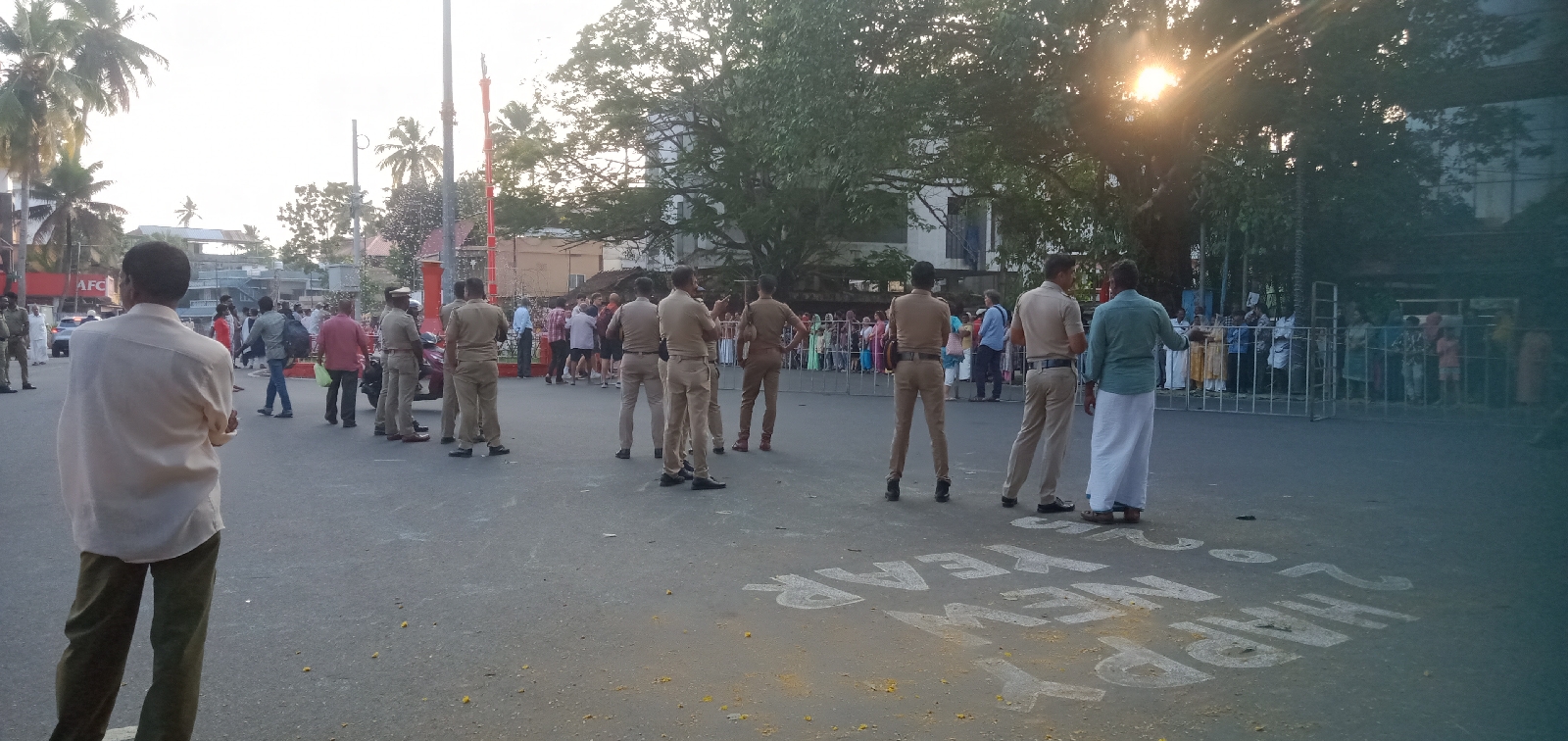
This year though, the spirit was glum with Cyclone Ockhi and its disastrous aftermath. The authorities who run the Carnival had to shift the venue to Parade ground from the beach as there was no beach this year. The high tide and the rising sea after the storm had taken over the beach which used to be the venue for many events of the Christmas and New year Celebration at the fort. 

Burning of the Pappanji at the Parade Ground on New year eve, the last event of the year. 


Ofcourse, the children got the best view. :)

Tourists finding vantage points on their hotel walls for better photo opportunity of the carnival procession. 

The long evening lights keeping the spirits up on the New year evening at River Road, Fort Cochin. 

All around the Fort streets locals and tourist were waiting patiently for the carnival procession to arrive. 

Dharma, Karma and The Cross

The Dharma, Karma and The Cross Between birth and death stretches the quiet field of a human life. What came before our birth remains hidden...